
Veterinary Technology / Commerce / AI
Vetlexicon
Connecting veterinary knowledge, customer accounts and AI in one working service.
- My role
- Technical Lead — platform delivery, ecommerce API development and AI evaluation
- When
- September 2024 – September 2026
What came of it
Account management moved from staff to customers
Available by departure to all accounts except large corporates. Deletion and cancellation remained staff-managed.
Reduction in base CRM platform cost
HubSpot to GoHighLevel comparison, excluding additional AI costs.
AI users in the first weeks after launch
Approximate figures at departure in September 2026, including around 80 paying users.
The brief
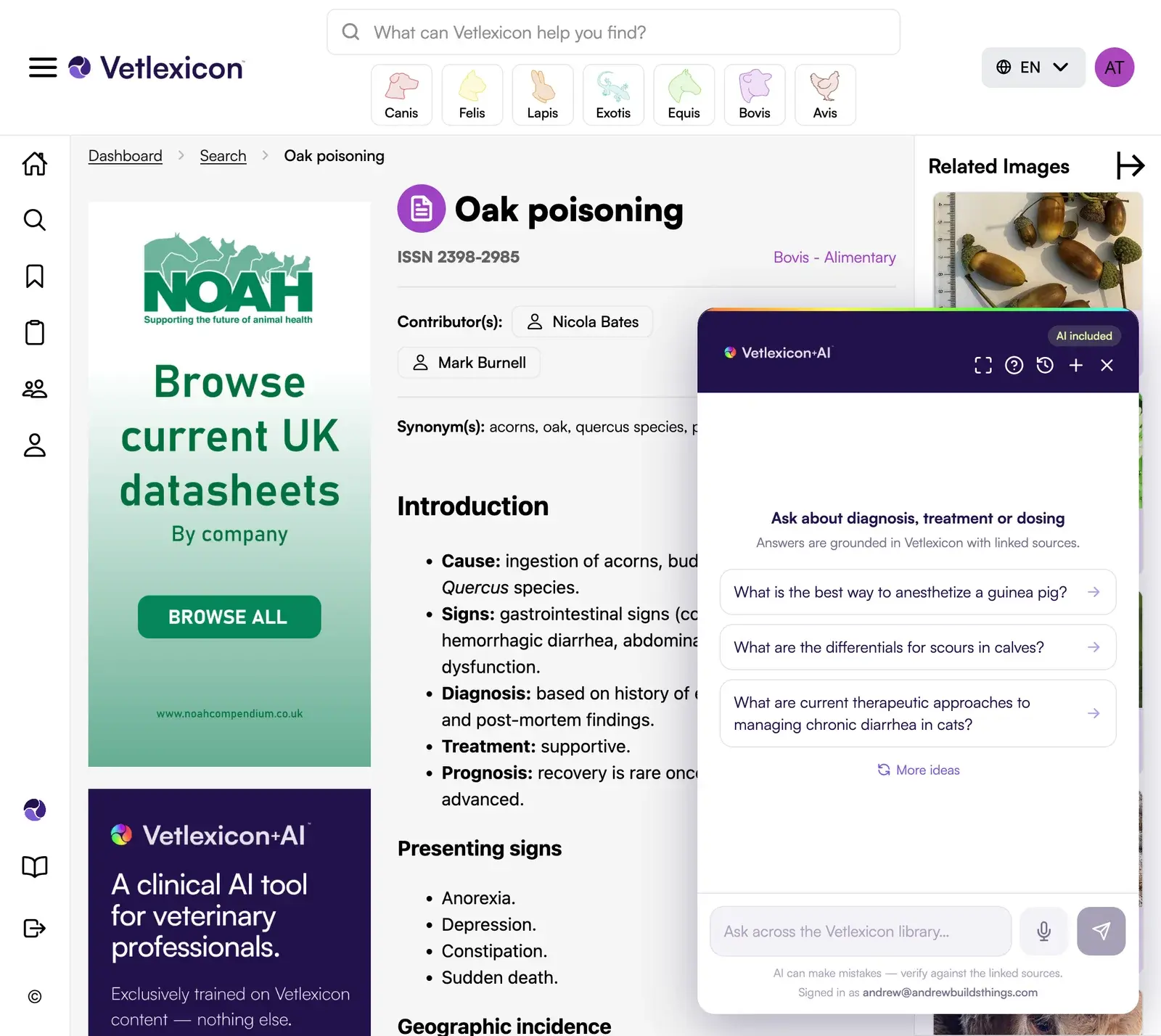
Vetlexicon’s WordPress platform had accumulated responsibilities across marketing, clinical publishing, commerce, identity and automation. Customers depended on staff to manage their accounts. When I joined in 2024, I audited the platform and proposed its replacement. Alongside the rebuild, we wanted to make decades of veterinary knowledge useful during everyday clinical work through Vetlexicon+AI.
What I did
- Audited the platform, proposed its replacement architecture and managed delivery with a new development agency.
- Built the ecommerce and customer-management API, including dynamic pricing, account pages, payment and access logic.
- Moved customer data into Frontegg and GoHighLevel and connected account changes to access and email workflows.
- Jointly designed the AI architecture, developed the content-export and tagging script, and led clinical testing and feedback.
- Proposed the AI agent approach and connected individual AI licences to species subscriptions.
- Set up observability and reporting, including Vercel error alerts into Slack.
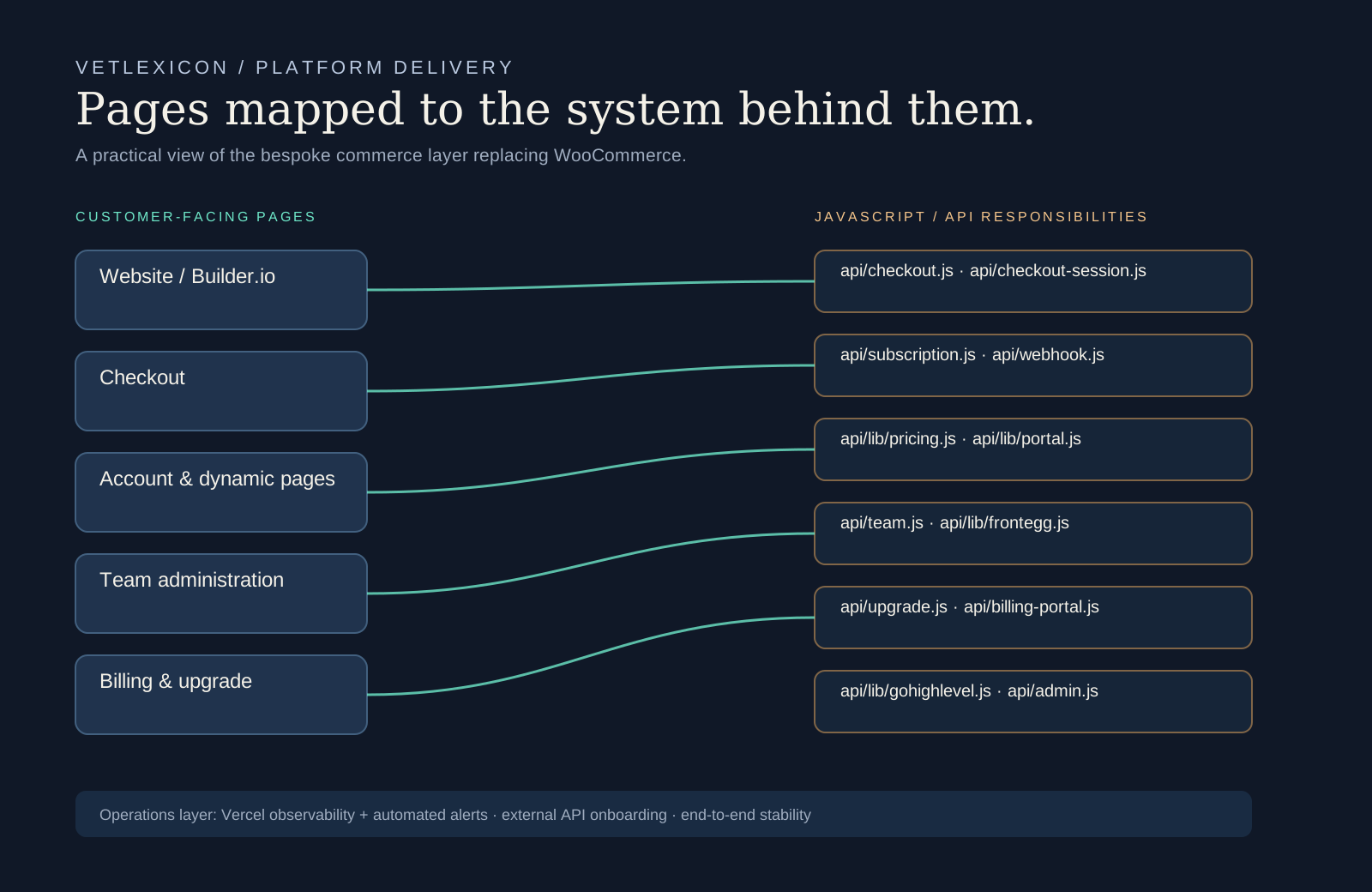
The services behind the customer journey
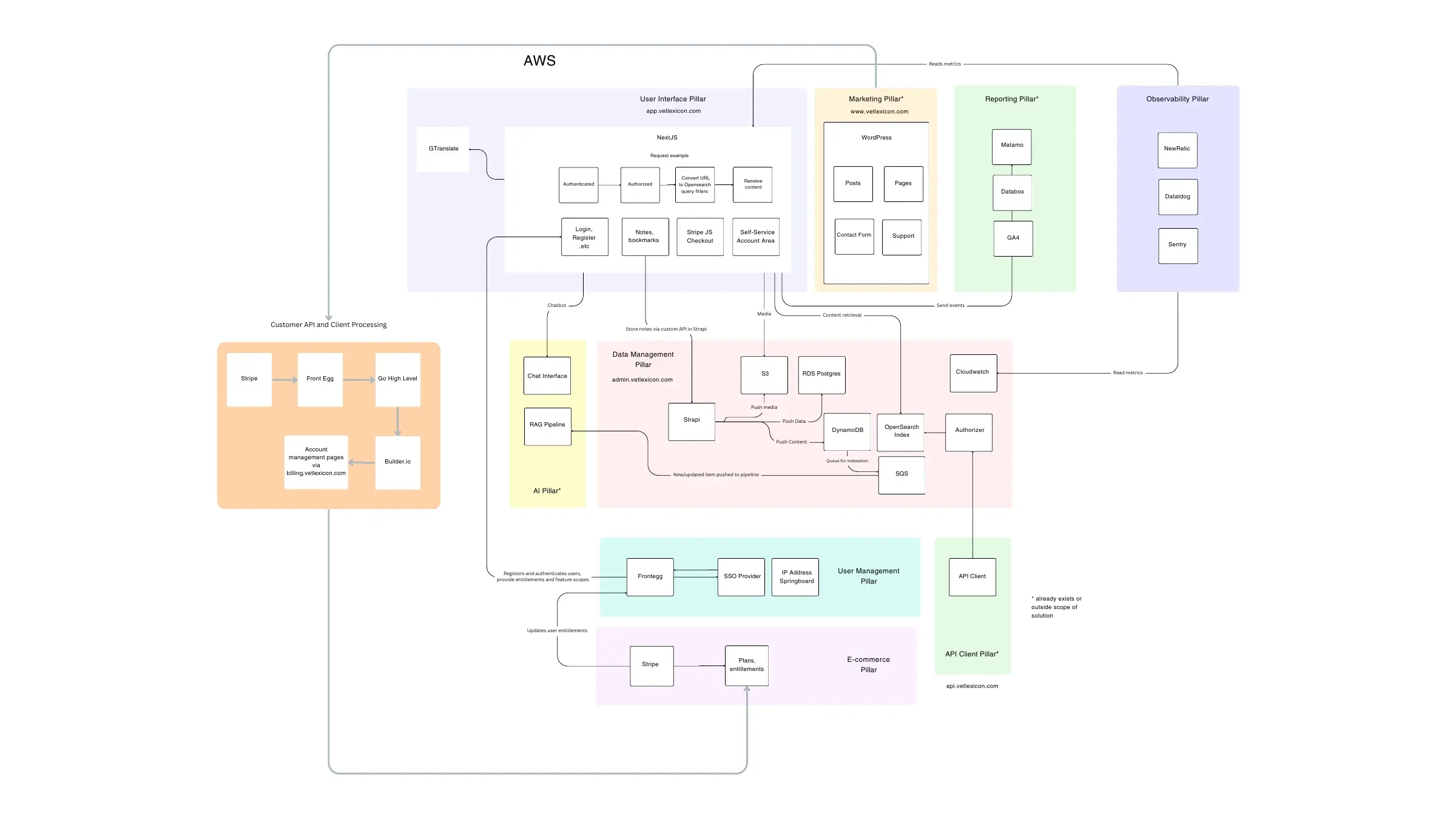
A service overview, with delivery and reliability spanning the build. Open each area for its role in the platform.
01WebsiteBuilder.io
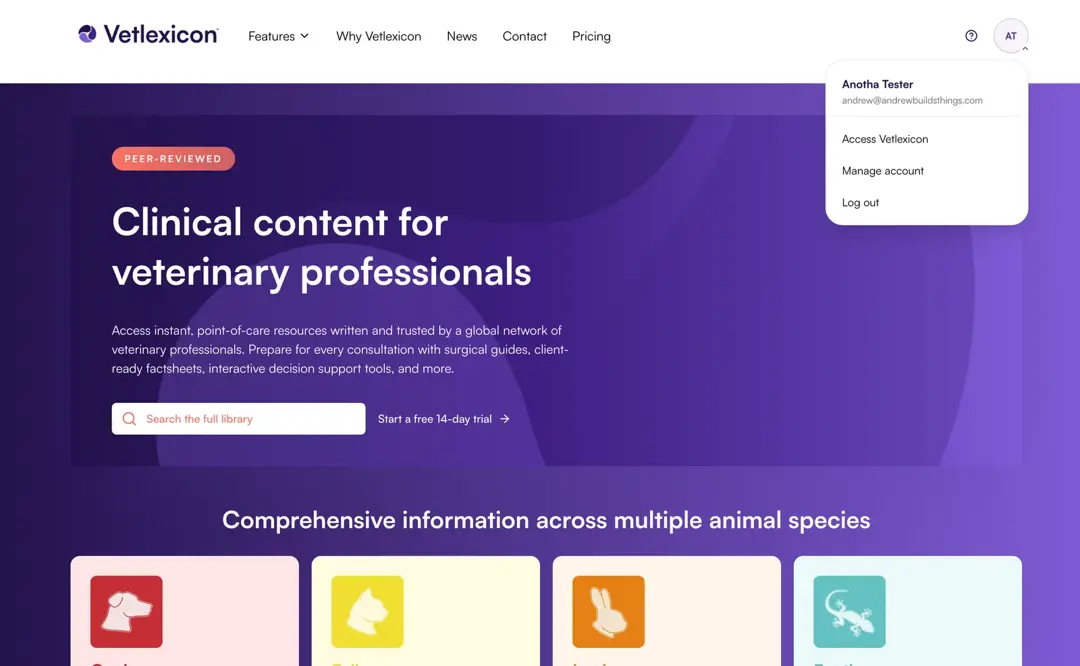
The customer-facing website and the entry into the subscription journey, delivered as part of the web build I project-managed.
02SubscriptionsStripe
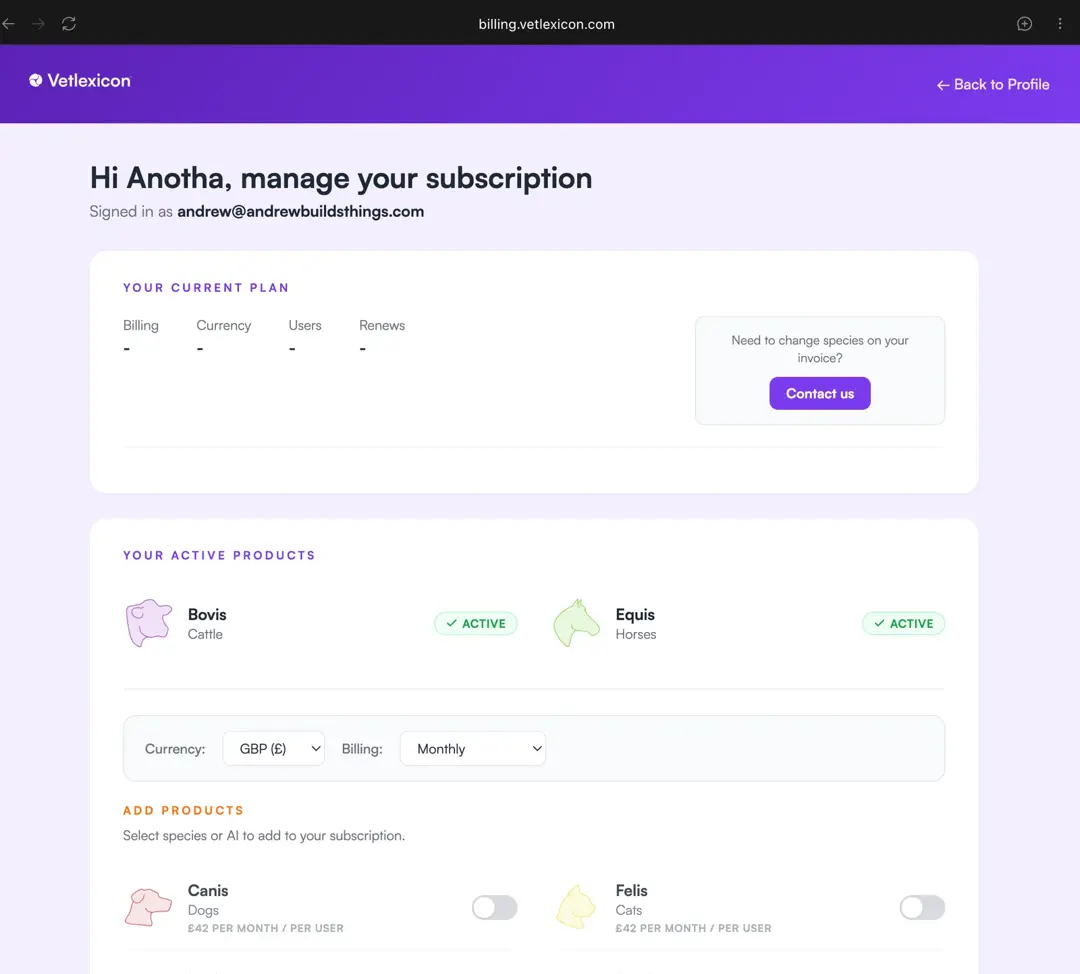
Checkout, billing and subscription management, including upgrade and team-seat purchase flows in the integration.
03Identity & accessFrontegg
Account and tenant provisioning, team membership and entitlements that connect subscriptions to user access.
04Customer lifecycleGoHighLevel
Contact integration and lifecycle automation, including abandoned and recovered checkout handling in the repository.
05DeliveryProject management · API onboarding
Coordinating the web build and onboarding external API providers as part of the overall delivery.
06ReliabilityVercel · observability · alerts
Setting up operational visibility and automated alerts, with responsibility for end-to-end stability.
From platform architecture to everyday use
Over two years at VetStream, I proposed the platform architecture, managed delivery and built the ecommerce and customer-management API from scratch. In parallel, I jointly designed the AI architecture with a developer and led content preparation, clinical testing and feedback. The two projects met in the customer journey: identifying the user, understanding their subscriptions and giving them access to the right knowledge and tools.
Give each part of the business room to change
My audit and experience maintaining the existing site led me to propose a replacement architecture. Marketing pages and medical content needed distinct publishing responsibilities, while commerce, identity and customer communications needed to work across the new services. Everything moved off WordPress. I built the ecommerce and customer-management connections and handled the customer data moving into Frontegg and GoHighLevel; the agency delivered the other platform components. The new platform launched on 7 April 2026.
Connect identity, payment and access
The API was the part I was most proud of building. It had to recognise different customer types across SSO, institutional IP access and team accounts, obtain Frontegg tokens and read information across platforms before deciding what someone could buy or access. Someone else implemented the institutional login bypass; my layer had to understand those incoming users. A Stripe payment then needed to result in the correct Frontegg plan and the right GoHighLevel email workflow. Dynamic account pages and pricing depended on those connections remaining consistent.
Put account changes in customers’ hands
Previously, customers needed staff to manage their accounts. By the time I left, all accounts except large corporates could manage their own accounts, with deletion and cancellation still handled by staff. We tested using dedicated accounts and company cards, with Client Services leading participation and colleagues across the company involved. Publishing became more controlled, although not faster. Login support still included resolving email-delivery problems and legacy email addresses. I configured Vercel error alerts into Slack to make operational issues visible.
Bring thirty years of knowledge into the consultation
Vetlexicon was used for research and continuing professional development. Our ambition was to make its knowledge useful before, during and after appointments and procedures, across the many species and disciplines vets encounter. A developer and I jointly designed the AI architecture using MongoDB, Pinecone and Render. She implemented the Python system; I developed and ran a script through WP All Export to organise roughly 29,000 pieces of content by species, category, subcategory, topic and date or WordPress ID. That preparation supported retrieval of relevant source material for answers.
Create a clinical feedback process
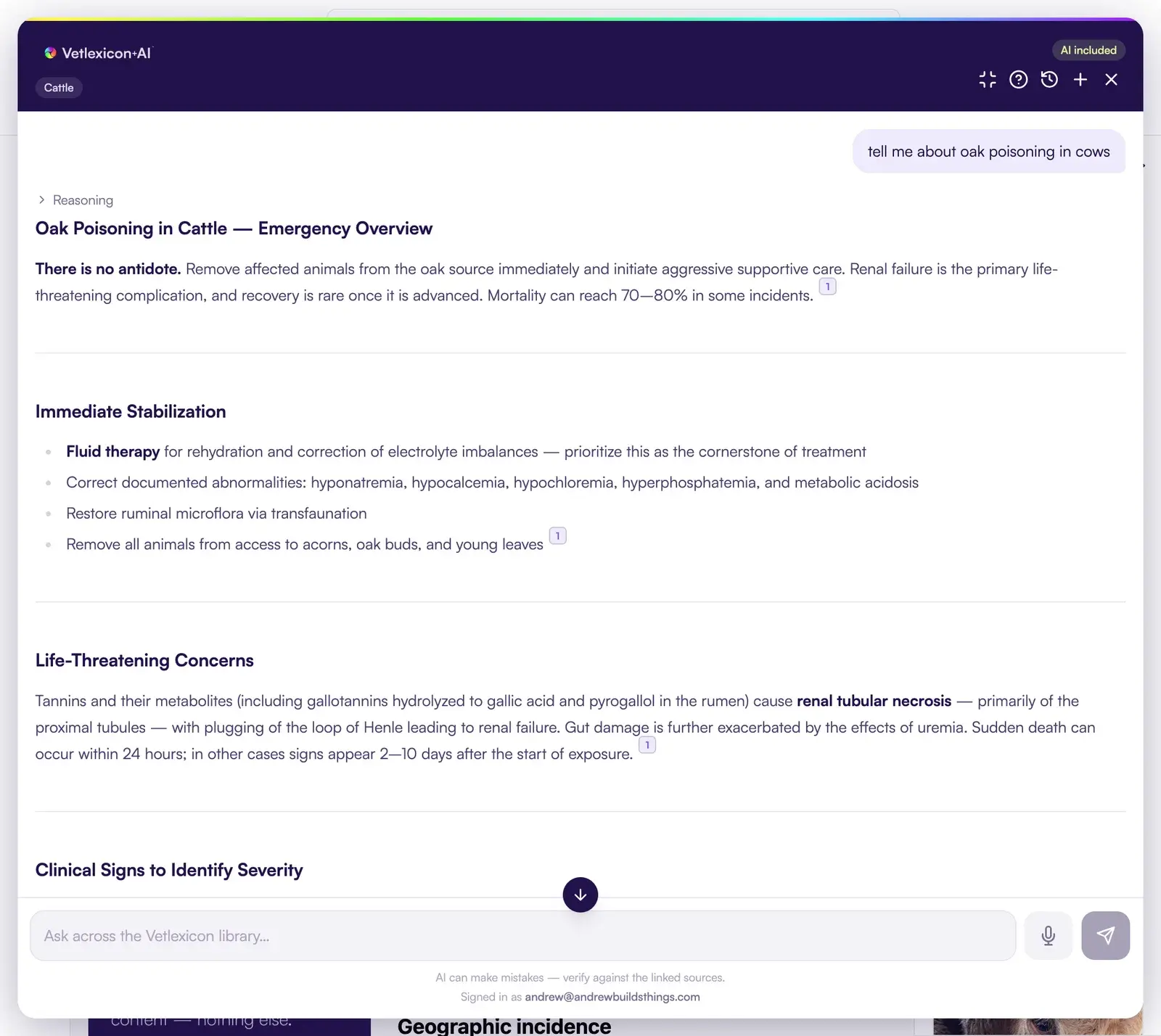
From April 2025, I ran testing and feedback with seven clinical reviewers, including vets, nurse practitioners and editorial staff. Almost 20,000 prompts were tested manually. Batches of 50 questions covered clinical workflows and species, with a consistent veterinarian-answer control. Early problems included hallucinations, incorrect attribution and omissions. Together we refined instructions, citation logic and answer formats. I proposed moving to agents responsible for workflow selection, prompt interpretation, citations, confidence scoring and model switching. The developer implemented that approach. The model’s self-reported confidence was separate from the clinical reviewers’ judgement.
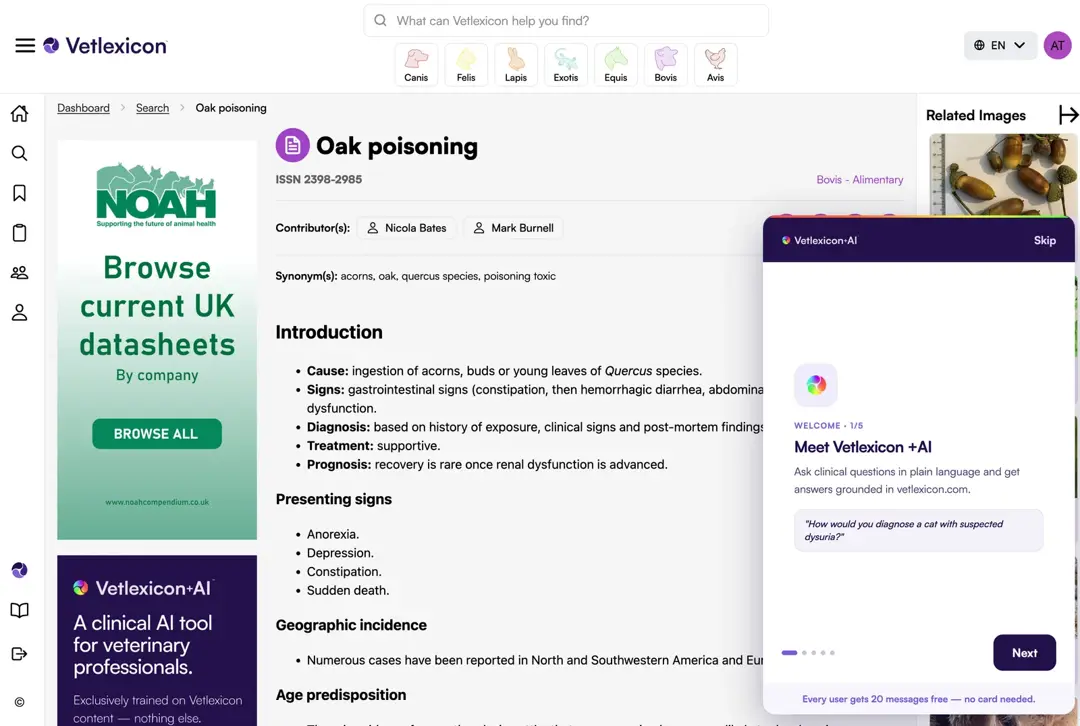
Make AI part of the subscription experience
In June 2026 we reached the evaluation threshold: at least 90% green-rated answers over a month, equivalent to 315 of 350 in a full round. Amber meant incomplete but potentially acceptable; red meant clinically inaccurate or dangerous. Some red ratings remained, so this was a reviewer-defined release threshold, not a guarantee of clinical accuracy. June to August covered the widget build and login testing. I used Frontegg’s SDK and my API to connect species subscriptions, conditional pricing and individual AI purchases. Tenant membership alone could not grant paid AI access. Eligible species subscribers received 20 free prompts, and the two-species eligibility rule determined access to the £10 AI offer.
Deliver with clear ownership
The widget launched in August 2026 as the first application of the AI service, with third-party licensing a future ambition. Approximate adoption rose from 500 beta users and 50 paying users to more than 1,000 users and around 80 paying users in the first weeks after launch. I managed delivery, while the Head of Operations managed budget. The returning Technical Lead owned content migration and Strapi implementation. Those responsibilities sat alongside my API development, customer-data handling, AI preparation, evaluation and operational reporting.