
5 AI Powered Marketing Workflows to Save 10 Hours a Week
Five practical AI marketing workflows that take repetitive work off your week, with the human checkpoints that keep the output worth publishing.
Why are you still spending every Friday afternoon copy-pasting data into spreadsheets like it's 2015? Most marketers feel like AI powered marketing workflows are just another complex tool to manage instead of a genuine helper. It's frustrating to watch your weekend slip away whilst you're stuck consolidating data or trying to maintain a social media schedule that never seems to scale. You shouldn't have to choose between consistency and your sanity.
You can stop the manual grind by implementing specific systems that act as a digital assembly line for your most repetitive tasks. These aren't theoretical concepts or overblown promises. They're grounded, functional workflows designed to handle the boring bits of marketing so you can focus on actual strategy. Reclaiming ten hours of your working week isn't about working harder. It's about building better systems.
In this article, we'll break down five pragmatic workflows you can set up yourself or hand over to a junior team member. We'll also look at how to measure your AI-readiness before you spend a single pound on new software. It's time to stop managing tools and start making them work for you.
Key Takeaways
-
Stop paying the "manual tax" by replacing repetitive data entry with automated logic that triggers tasks based on data instead of manual clicks.
-
Discover five pragmatic AI powered marketing workflows designed to handle lead responses and content scaling whilst saving you ten hours every week.
-
Avoid the trap of "AI slop" by using human-in-the-loop checkpoints to maintain high quality across all your automated outputs.
-
Identify if your business is actually prepared for automation by performing a readiness audit on your current data hygiene and internal processes.
-
Learn how to scale your operations efficiently by choosing between custom-built logic and ready-made framework libraries to bypass the blank page problem.
Table of Contents
Beyond the Hype: Why Manual Marketing is a Leaky Bucket in 2026
Stop thinking of AI as a chat box where you type a request and wait for a reply. In 2026, the most effective teams have moved past simple prompting. They're building AI powered marketing workflows that operate whilst the team sleeps. A genuine workflow isn't a manual task assisted by a tool. It's a series of automated steps triggered by data, not by a human clicking "send" or "copy." If you're still manually moving data between your CRM and your content tools, you aren't using AI; you're just a highly paid data entry clerk.
The evolution of Artificial Intelligence in Marketing has shifted from predictive analytics to autonomous systems. We call the cost of human intervention the "Manual Tax." Every time a marketer has to switch contexts to format a spreadsheet or resize a social graphic, they lose creative momentum. This friction doesn't just waste time. It increases error rates and ensures your best people are stuck doing the work a machine could handle for pennies.
The Anatomy of a High-Performing Workflow
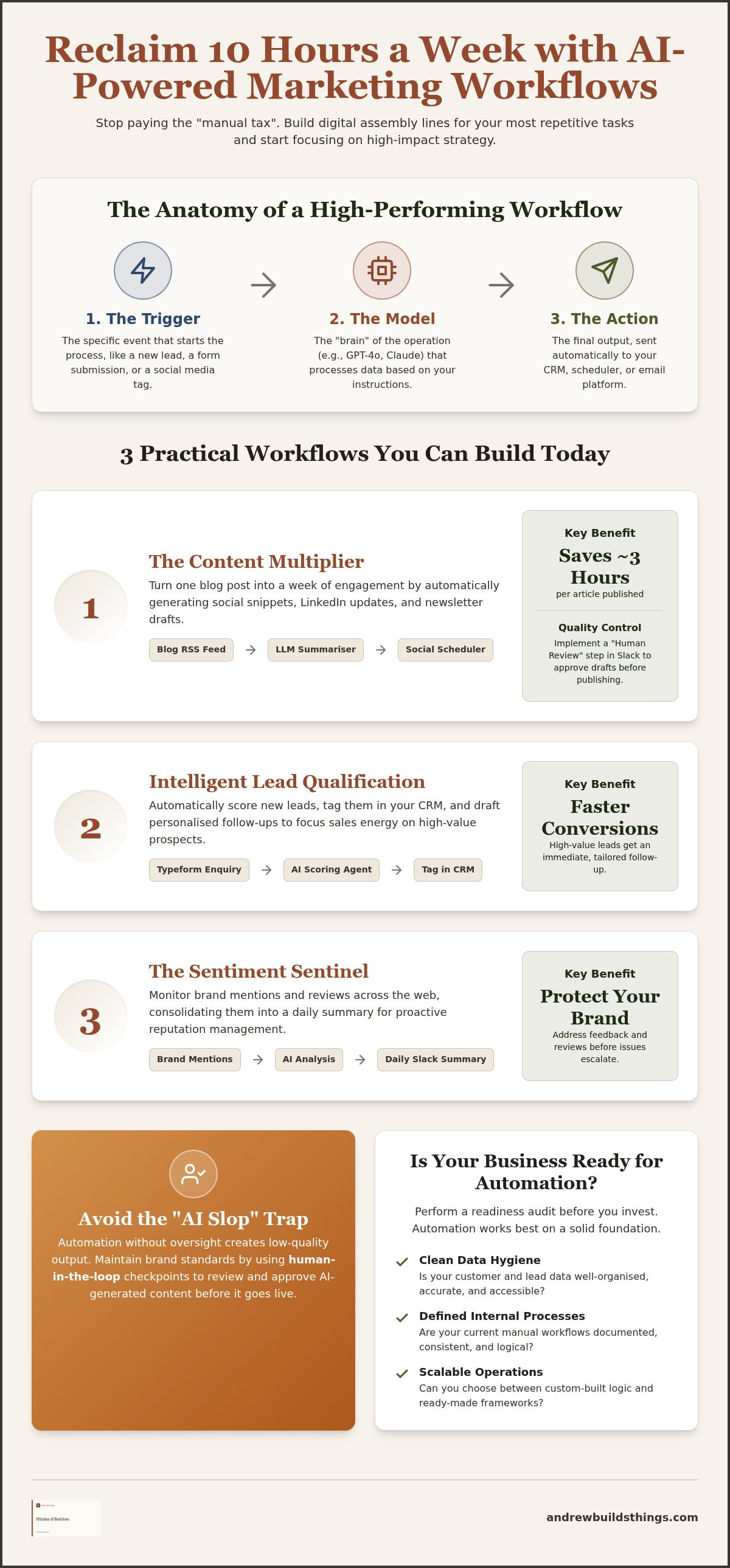
Building a functional system requires three distinct components. It's the difference between using a tool like ChatGPT and creating a sequence that connects your entire tech stack. A robust workflow follows a logical chain:
-
The Trigger: This is the specific event that starts the process. It might be a new lead appearing in a Google Sheet, a calendar booking, or a tagged post on LinkedIn.
-
The Model: This is the "brain" of the operation. You might use Claude for its nuanced writing style or GPT-4o for complex data reasoning. The workflow sends the trigger data to the model with specific instructions.
-
The Action: This is the final destination. The processed data is sent automatically to your social media scheduler, your email platform, or your CRM.
Why "Good Enough" is No Longer Enough
Relying on manual processes creates a bottleneck that kills conversion rates. In the UK market, buyers expect immediate responses. If a lead waits four hours for a reply because your team was "busy," they've already moved on to a competitor. Manual marketing also leads to a fragmented brand voice. When five different people are manually drafting posts across five channels, consistency evaporates. AI powered marketing workflows solve this by applying your specific brand guidelines across every output, ensuring every touchpoint feels like it came from the same person. It's about precision, not just speed.
5 Practical AI Workflows to Reclaim Your Working Week
Building AI powered marketing workflows isn't about finding a "magic button" that does your job for you. It's about connecting the tools you already use into a logical, automated sequence. Most marketers fail because they treat AI as a destination rather than a bridge between tasks. By creating a digital assembly line, you ensure that high-value work happens whilst you focus on strategy. Here are five functional systems that solve specific marketing headaches.
Workflow 1: The Content Multiplier (Deep Dive)
The Content Multiplier turns one piece of work into a week of engagement. The logic follows a clear path: your Blog RSS Feed triggers an LLM to summarise the post into social snippets, LinkedIn updates, and a newsletter draft. These outputs are then pushed automatically to a scheduler like Buffer or Hootsuite. This process saves roughly three hours per article because you aren't manually "chunking" text for different platforms. A pro tip for maintaining quality: always include a "Human Review" step in a Slack channel. Your team can approve or edit the drafts before anything goes live, catching any potential hallucinations early.
Workflow 2: Intelligent Lead Qualification
This system stops you from wasting time on "tyre-kickers" who aren't ready to buy. When a prospect submits a Typeform enquiry, an AI scoring agent evaluates the response based on your ideal customer profile. It then tags the lead in your CRM, such as HubSpot or Pipedrive, and drafts a personalised reply in Claude. High-value leads get an immediate, tailored follow-up that improves conversion rates. Lower-value leads are automatically moved to a nurture sequence. This ensures your sales energy is spent only where it counts.
Other essential AI powered marketing workflows include:
-
The Sentiment Sentinel: This monitors brand mentions and reviews across the web, consolidating them into a daily Slack summary for your team to address.
-
The SEO Strategist: By connecting Search Console data to an AI agent, you can generate weekly reports that identify "low-hanging fruit" keywords where you're ranking on page two and need a slight push.
-
The Meeting Alchemist: This converts Zoom transcripts into action items, LinkedIn summaries, and even rough blog drafts immediately after the call ends.
Experts at Harvard suggest that AI will fundamentally shape the future of marketing, but only for those who can actually build these systems. If you want to skip the trial and error of building these from scratch, you can find pre-built logic in my Framework Library. It's the fastest way to stop managing tools and start managing results.
Avoiding the "AI Slop" Trap: Maintaining Quality Control
AI slop is the grey, uninspired content currently flooding LinkedIn feeds and ruining email open rates. It is the hallmark of lazy automation. If your AI powered marketing workflows produce generic phrases like "in the rapidly evolving digital landscape," you are damaging your brand. Customers can smell a machine-generated template from a mile away. Quality control is not a luxury. It is a survival requirement for any business that wants to scale without losing its soul.
You don't need a £500 monthly enterprise subscription to maintain high standards. You simply need a "Human-in-the-Loop" (HITL) step. This is a manual approval point where a real person reviews the machine's output before it reaches the customer. Automation should handle the heavy lifting of drafting and formatting, but a human should always provide the final 10 percent of polish. It is the difference between a helpful automated reply and a PR disaster.
Your prompt engineering should be treated as a core brand asset. Instead of giving your LLM vague instructions, build a comprehensive "Style Guide" into your system prompts. Tell the model exactly who it is: a pragmatic UK-based expert who loathes jargon and uses British English spelling. This turns your workflow into a living programme that reflects your unique perspective rather than a generic echo of the internet.
Setting Up Your Quality Gate
Use conditional logic to protect your brand. In tools like Zapier or Make, you can set "if/then" rules that flag sensitive AI outputs for manual review. If the AI's confidence score is low or the sentiment is unclear, the workflow should pause and alert a team member in Slack. Another effective tactic is the "Critique Agent." You can set up one AI model to check the work of another against a specific checklist of your brand rules. This internal audit happens in seconds and catches errors before they ever leave your internal system.
The Importance of Data Privacy in the UK
UK marketers must remain strictly GDPR compliant whilst using cloud-based AI models. It is your responsibility to ensure that customer data remains secure. Never send Personally Identifiable Information (PII) like full names, home addresses, or financial details directly to an LLM. Always "clean" your data first. You can use automated steps to anonymise sensitive fields before the data hits the cloud. This ensures your AI powered marketing workflows stay on the right side of the law whilst still delivering the efficiency gains you need.
Is Your Business Ready? The AI Readiness Audit
Buying a new tool before you have a solid process is a recipe for expensive failure. It's the "shiny object" trap that costs UK businesses thousands of pounds every year. You cannot automate a mess. If your current marketing operations are chaotic, adding AI powered marketing workflows will only help you produce chaos faster. Before you spend a single pound on a Claude subscription or a Zapier plan, you must determine if your foundation is stable enough to support automation.
True readiness rests on three specific pillars. First is your technical infrastructure. Do your existing tools actually talk to each other? If your CRM is a closed system without an API, you're stuck. Second is your team's skillset. Your staff don't need to be coders, but they must understand how to guide an LLM and review its work. Finally, there is process maturity. You can only automate a task that has a clear, repeatable set of steps. If you "wing it" every time you write a newsletter, a machine cannot help you.
Data hygiene is the silent killer of automation projects. AI models are only as good as the information you feed them. If your lead data is fragmented across five different spreadsheets with inconsistent formatting, your automated responses will be inaccurate. Organising your data isn't the most exciting part of the job, but it's the most essential. Clean data is the fuel that makes your automation run whilst you focus on higher-level strategy.
Conducting a Quick Internal Audit
Start by creating an "I hate doing this" list. Sit down with your team and inventory every repetitive, soul-crushing task that eats up their Friday afternoons. These are your primary automation gaps. Once you have this list, map your tech stack. Check if your favourite tools have native integrations or if they connect to platforms like Make or Zapier. If a tool doesn't have an API or a connector, it's a bottleneck that needs to be addressed or replaced before you move forward.
The AI Readiness Assessment
Identifying where to start can be overwhelming. To find your specific starting point and avoid wasting resources, you should Take the AI Readiness Assessment. This diagnostic tool evaluates your current operations and highlights exactly which pillars need work before you begin building. It's a pragmatic way to ensure you aren't building on sand.
By understanding your current maturity level, you can prioritise which of the five workflows mentioned earlier will deliver the fastest return on investment. Don't guess. Use data to decide your next move. If you want to stop the manual grind, check your AI readiness here to get a clear, actionable roadmap for your business.
Scaling Your Operations with Ready-Made Frameworks
You've identified your automation gaps. You know which tasks are killing your productivity. Now you face the "Build vs. Buy" debate. Building your own AI powered marketing workflows from the ground up is often a trap. You'll spend your time fixing broken API connections and debugging logic instead of growing your business. For most UK marketing teams, starting with a proven foundation is the only way to scale without hiring a full-time developer.
A "Framework First" approach allows for much faster deployment. It's about using reusable logic that has already been tested in real-world scenarios. This method reduces technical bugs and ensures your systems are robust from day one. Once you have a few core frameworks running, you can stop thinking about individual tasks and start building a fully automated marketing operations centre. This is how you move from saving a few hours to fundamentally changing how your business functions.
Leveraging the Framework Library
My Framework Library is designed to bypass the "blank page" problem. It provides the underlying logic for the most common marketing hurdles. Inside, you'll find pre-built structures for lead follow-up, multi-channel content distribution, and automated search visibility reporting. These aren't rigid templates. They're flexible systems you can customise to fit your specific brand voice and internal processes. You get the speed of a ready-made solution with the precision of a custom build.
Customising a framework is straightforward. You keep the triggers and the data flow, but you swap in your unique brand guidelines and specific model instructions. This ensures that whilst the machine handles the movement of data, the output still sounds exactly like your team. It's the most efficient way to maintain quality whilst increasing your output by tenfold.
Your Brand in the Age of AI Search
Traditional SEO is no longer the only game in town. You need to understand how your brand is being presented by autonomous agents and AI-driven search engines. If your workflows don't include monitoring for how models like Perplexity or SearchGPT perceive your business, you're missing a critical piece of the puzzle. These models synthesise information differently than a standard Google results page.
You can't optimise what you can't see. To stay ahead of this shift, you should Book an AI Search Visibility Audit. This audit reveals exactly how these new models are categorising your brand and where your "visibility gaps" are. It's the essential next step for any business that has already started using AI powered marketing workflows and wants to dominate the next era of digital discovery. Don't leave your brand's reputation to a machine's hallucination. Get the data and take control.
Build Your Digital Assembly Line
Reclaiming ten hours of your working week isn't a pipe dream. It's a matter of structural engineering. You've seen how AI powered marketing workflows transform repetitive data entry into a streamlined assembly line. By focusing on readiness first and maintaining human-in-the-loop quality control, you ensure your brand remains authentic whilst your output scales. Consistency is no longer a trade-off for your sanity. You've done the manual work long enough.
Don't waste months trying to build these complex systems from scratch. You can bypass the technical hurdles by using proven logic designed specifically for UK SMEs. Whether you need an expert-led AI Readiness Assessment or a library of reusable logic, the tools are ready for you to deploy today. It's time to let the machines handle the boring bits so you can get back to the creative strategy that actually moves the needle. Your weekend is waiting. Let's build something better.
Download the AI Marketing Framework Library today and stop paying the manual tax.
Frequently Asked Questions
What is the best tool for building AI marketing workflows in 2026?
The best environment for building AI powered marketing workflows in 2026 is a combination of an orchestration platform like Make and a high-reasoning LLM like Claude 3.5 Sonnet. Whilst many individual tools claim to do everything, they often lack the flexibility of a custom-built sequence. By connecting your existing CRM directly to an LLM via an API, you maintain control over your data flow without being locked into a single vendor's ecosystem.
Do I need to know how to code to set up these AI workflows?
You don't need any coding knowledge to build these systems. Modern platforms like Zapier and Make use visual, drag-and-drop interfaces that allow you to map out your logic without writing a single line of Python or Javascript. Most of the "heavy lifting" is done through pre-built connectors. If you can use a spreadsheet and understand basic "if this, then that" logic, you have enough technical skill to automate your marketing operations.
How much time does it actually take to set up an automated content workflow?
A standard automated content workflow usually takes between two and four hours to build and test. This includes setting up your triggers, refining your LLM prompts, and ensuring the data lands correctly in your social scheduler or CMS. Whilst the initial setup requires a small time investment, it's a one-off task. Once the logic is verified, the system will continue to save you hours every single week without further manual intervention.
Is AI marketing automation expensive for a small business?
Automation is highly cost-effective for small businesses because it scales based on your usage. You can start with basic plans for around £20 to £30 per month, which is significantly cheaper than hiring a junior assistant or a freelancer. The true value lies in the reclaimed time. If you save ten hours a week at a standard professional rate, the return on investment is immediate and measurable within the first month of operation.
Will using AI-powered workflows hurt my SEO or brand reputation?
Automation only hurts your reputation if you use it to produce generic "slop" without human oversight. Google's algorithms prioritise helpful, original content regardless of how it was produced. By keeping a human-in-the-loop for final approvals, you ensure your brand voice remains consistent and your facts are accurate. Well-executed AI powered marketing workflows actually improve SEO by allowing you to maintain a consistent publishing schedule that would be impossible to manage manually.
Can I use free versions of ChatGPT and Zapier for these workflows?
You can start with free versions for very basic tasks, but you'll quickly hit limitations. Most functional workflows require multi-step logic and API access, which are usually locked behind paid tiers. For example, Zapier's free plan only allows for simple two-step automations. To build a truly useful system that handles complex data processing, you should budget for the entry-level professional plans to ensure your workflows don't break under heavy load.
What is the difference between Zapier and Make for marketing automation?
Zapier is built for speed and ease of use, whilst Make is designed for complex logic and cost-efficiency at scale. Zapier has more native "plug and play" integrations, making it ideal for beginners. Make offers a more visual canvas and allows for more granular control over your data, which usually results in lower monthly costs for high-volume tasks. Most marketers start with Zapier and migrate to Make as their automated systems become more sophisticated.
How do I ensure my AI workflows are GDPR compliant?
GDPR compliance requires you to be disciplined with how you handle customer data. You must ensure you have a Data Processing Agreement (DPA) with any tool you use and avoid sending sensitive personal information to LLMs. Always "clean" your data by removing names or addresses before the automation step begins. It's also vital to check where the AI model's servers are located and ensure your privacy policy accurately reflects your use of automated processing.